
Microcrystalline Cellulose Market to Grow from USD 1.54 Billion in 2026 to USD 2.72 Billion by 2035 at 6.85% CAGR
Microcrystalline Cellulose MCC Market (2026 - 2035)
North America held approximately USD 0.40 billion in 2025 market value, anchored by dietary supplement ingredients demand
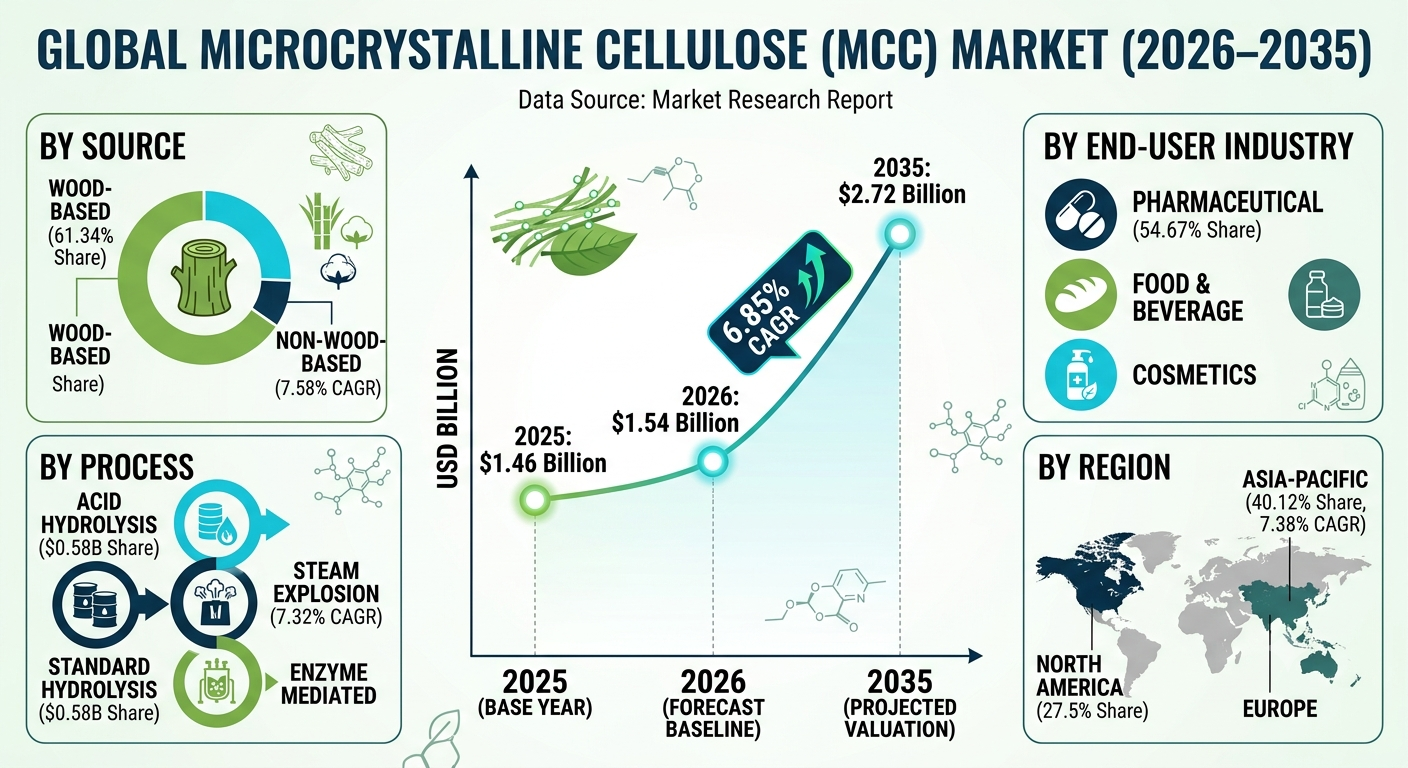
WA, UNITED STATES, August 25, 2026 /EINPresswire.com/ -- The global microcrystalline cellulose market is entering a period of robust expansion driven by the intersection of generic pharmaceutical manufacturing, clean-label food reformulation, and the natural cosmetics revolution. Valued at an estimated $1.46 billion in 2025, the market is projected to grow from $1.54 billion in 2026 to approximately $2.72 billion by 2035, registering a compound annual growth rate of 6.85%. This trajectory is anchored by the relentless scaling of tablet production across South and Southeast Asia, tightening European mandates on synthetic food additives, and a structural shift toward plant-derived personal care ingredients that is converting microcrystalline cellulose from a commodity excipient into a strategic formulation input.The Technology Transition: From Batch Acid to Continuous Processing
A fundamental shift is underway in how cellulose powder is produced. Legacy batch acid-hydrolysis lines, long the workhorse for pharmaceutical tablet binding agents, are steadily giving way to continuous steam-explosion and enzyme-mediated processes that cut energy consumption by 25 to 30% and reduce chemical waste streams. The European Chemicals Agency's updated REACH dossier for microcrystalline cellulose powder grades, finalized in late 2024, has accelerated this transition by rewarding low-emission processing with expedited registration pathways. Capital commitments exceeding $320 million toward cellulose processing capacity expansions in India and China during 2024 and 2025 underscore the commercial momentum behind purified cellulose supply chains.
Steam explosion is the fastest-growing process segment, projected to expand at a 7.32% CAGR through 2035. A single steam-explosion line can achieve 30% higher throughput than an equivalent acid-hydrolysis system while consuming 25% less electricity, according to a 2024 lifecycle assessment published by the European Cellulose Research Institute. Capital expenditure for a 10,000 metric ton per year steam-explosion facility runs approximately $18 to $22 million, roughly 40% less than an equivalent acid-hydrolysis plant, making the technology accessible to mid-tier cellulose powder producers in Southeast Asia and Latin America. Enzyme-mediated processing, valued at approximately $120 million in 2025, offers mild processing conditions valued for specialty functional food additives. Reactive extrusion is growing at a 6.48% CAGR, enabling continuous processing for high-volume cellulose powder output.
Acid hydrolysis retains the dominant position, generating approximately $580 million in 2025. Decades of regulatory validation and optimized operating parameters for pharmaceutical-grade output keep this process entrenched, with major producers operating plants at 85 to 90% utilization rates. Process improvements now focus on acid recovery and recycling systems that reduce hydrochloric acid consumption by 15 to 18% per batch cycle.
Download Report Sample Copy with TOC: https://www.marketresearchfuture.com/sample_request/5614
Segment Analysis by Source
Wood-based sources overwhelmingly dominate the microcrystalline cellulose market, capturing approximately 61.34% of revenue in 2025. This dominance reflects deep integration with established dissolving-pulp supply chains for pharmaceutical excipients, where Scandinavian and North American hardwood species such as birch and eucalyptus deliver consistent alpha-cellulose content above 92%. Predictable tablet binding agent performance and narrow particle-size distributions, combined with extensive Drug Master File registrations, entrench wood-based purified cellulose as the default choice for regulated pharmaceutical applications.
Non-wood-based alternatives represent the fastest-growing source segment, projected to expand at a 7.58% CAGR through 2035. Cotton linters, bamboo residue, and sugarcane bagasse present cost-competitive alternatives, particularly in Asia-Pacific and South America where agricultural byproducts are abundant. India's National Bamboo Mission has earmarked $150 million through 2027 for industrial bamboo processing, creating feedstock pipelines that producers can tap at 20 to 30% lower raw-material cost than imported hardwood pulp. Cotton linter-derived microcrystalline cellulose also offers distinct morphological properties valued in cosmetics formulations. Brazil's abundant sugarcane bagasse residue positions the country as a potential non-wood production hub, with the Brazilian Development Bank approving credit lines totaling BRL 450 million for bio-based chemical processing facilities through 2027.
Segment Analysis by End-User Industry
Pharmaceuticals anchor the market, accounting for approximately 46.10% of revenue in 2025. Microcrystalline cellulose serves as the most widely used filler-binder in oral solid dosage manufacturing globally, with over 65% of immediate-release tablet formulations listing it as a primary excipient component. This position is reinforced by extensive regulatory acceptance and decades of clinical safety data. India's Department of Pharmaceuticals allocated INR 3,000 crore, approximately $360 million, under the Production Linked Incentive Scheme Phase II to boost domestic formulation output through 2028, directly lifting demand for pharmaceutical excipients. Contract manufacturing organizations in Hyderabad and Ahmedabad added over 14 billion tablet units of annual capacity during 2023 and 2024, with purified cellulose constituting roughly 15 to 20% of typical tablet weight.
The food sector generated approximately $280 million in 2025, absorbing growing quantities of cellulose-based excipients as clean-label reformulation reshapes packaged food ingredient lists. Regulation (EU) 2024/1837 mandates that producers substitute organically derived stabilizers for synthetic stabilizers in certain product categories by January 2027. Microcrystalline cellulose, categorized as E460(i), stands to increase in volume as food stabilizer formulators replace synthetic emulsifiers and modified starches. Industry estimates suggest the reformulation wave might increase demand for cellulose-based excipients in the EU food sector alone by $85 to $110 million by 2030.
Cosmetics represents the fastest-growing end-user segment, advancing at a 7.52% CAGR. Global clean-beauty retail sales surpassed $48 billion in 2024, with formulators actively seeking plant-derived alternatives to synthetic fillers. Microcrystalline cellulose powder grades with controlled particle-size distribution between 10 and 50 micrometers offer oil-absorption and mattifying properties that compete directly with talc and synthetic silica in sunscreen formulas, pressed powders, and foundations. L'Oréal's 2024 Green Sciences pledge to source 95% bio-based ingredients by 2030 has prompted its contract manufacturers to qualify new sources of cosmetics-grade purified cellulose at scale.
Other end-user industries, spanning agricultural feed additives and industrial filtration, are growing at a 5.45% CAGR. Dietary supplement ingredients manufacturers drive incremental demand, using cellulose powder as a capsule filler and flow aid in vitamin and mineral formulations.
Buy Now: https://www.marketresearchfuture.com/checkout?currency=one_user-USD&report_id=5614
Regional Landscape: Asia-Pacific Dominates, All Regions Expand
Asia-Pacific commands the largest share of the global microcrystalline cellulose market at approximately 40.12% of revenue in 2025, and it is also the fastest-growing region with a projected 7.38% CAGR through 2035. This dominance stems from China's and India's combined pharmaceutical tablet output exceeding 400 billion units annually. China alone captures roughly 34.6% of the regional share, with the 14th Five-Year Plan for the pharmaceutical industry prioritizing domestic excipient self-sufficiency. India is the standout growth market within the region, expanding at a 7.82% CAGR, supported by the Production Linked Incentive scheme for pharmaceuticals and bamboo feedstock development. Japan contributed approximately $70 million, focused on high-purity pharmaceutical excipients standards. South Korea is growing at a 6.90% CAGR through K-beauty and functional food additives demand. The ASEAN bloc generated approximately $60 million, with generic pharma contract manufacturing driving consumption.
North America holds the second-largest position with approximately 27.5% of global revenue, generating roughly $400 million in 2025. The United States dominates with approximately 78.5% of regional share, driven by expansive generic drug and over-the-counter supplement manufacturing. The FDA's 2024 guidance on excipient qualification prompted formulators to re-validate purified cellulose suppliers, creating switching-cost barriers that benefit established producers with robust Drug Master Files. Canada is expanding at a 5.85% CAGR through natural health product regulations. Mexico contributed approximately $20 million, with generic pharma manufacturing growth lifting demand for tablet binding agents.
Europe follows closely, driven by adoption of cosmetics-grade cellulose-based excipients and clean-label food reformulation. Germany anchors the region with approximately 24.8% of European share, serving as a pharma and chemical excipient manufacturing hub with the Pharma-Standort initiative channeling EUR 2.1 billion into domestic active and inactive ingredient production through 2028. The United Kingdom is growing at a 6.72% CAGR through post-Brexit excipient re-registration demand. France contributed approximately $40 million, supported by cosmetics-grade cellulose demand. Italy is expanding at a 5.95% CAGR through food stabilizers for pasta and dairy sectors. The Nordic countries are growing at a 6.45% CAGR through sustainable pulp feedstock processing.
South America was valued at approximately $90 million in 2025. Brazil dominates with roughly 62.3% of regional share, leveraging sugarcane bagasse as a non-wood feedstock. Argentina is growing at a 5.78% CAGR through food stabilizers in dairy processing.
The Middle East and Africa is expanding at a 5.92% CAGR. Saudi Arabia leads with approximately 28.5% of regional share through Vision 2030 pharmaceutical localization targets. The United Arab Emirates is growing at a 6.18% CAGR through free-zone pharma manufacturing. South Africa contributed approximately $10 million, serving as a distribution gateway for generic drug production across Sub-Saharan Africa. Egypt is expanding at a 5.72% CAGR through domestic food stabilizers demand.
Report Summary: https://www.marketresearchfuture.com/reports/microcrystalline-cellulose-mcc-market-5614
Competitive Landscape
The microcrystalline cellulose market exhibits moderate concentration, with the top five producers collectively holding an estimated 48 to 55% of global revenue and an approximate Herfindahl-Hirschman Index between 850 and 1,050. Competition centers on process efficiency, regulatory dossier breadth, geographic proximity to major consumption clusters, and vertical integration into dissolving-pulp sourcing.
DuPont de Nemours, through its IFF Pharma Solutions division, leads with an estimated 10 to 14% revenue share. The company's Avicel product line represents the global benchmark for pharma-grade purified cellulose, with the broadest Drug Master File portfolio in the industry. In September 2023, IFF launched Avicel PH LN, a low-nitrile microcrystalline cellulose line designed to reduce nitrosamine formation risks in oral drug formulations. In March 2025, Roquette Frères cleared anti-trust approval from the Competition Commission of India to acquire IFF's Pharma Solutions division, integrating their global microcrystalline cellulose business to consolidate pharmaceutical excipient market share.
JRS Pharma captures roughly 8 to 12% of the market as a vertically integrated European producer with strong food and pharma dual positioning, offering the VIVAPUR and EMCOCEL ranges. Asahi Kasei Corporation holds approximately 7 to 10% through its CEOLUS pharmaceutical and food grades, serving as the Japanese quality benchmark with Asia-Pacific distribution strength.
Mingtai Chemical Company captures roughly 5 to 8% as a cost-competitive Taiwanese producer with strong ASEAN market presence. Accent Microcell holds approximately 4 to 7% as a leading Indian producer and Production Linked Incentive scheme beneficiary, specializing in pharma-grade microcrystalline cellulose and dietary supplement ingredients grades. Anhui Sunhere Pharmaceutical Excipients Company accounts for roughly 4 to 6% as the Chinese domestic market leader with scale-driven pricing.
Sigachi Industries holds approximately 3 to 5% as an Indian mid-cap with rapid capacity expansion under its SIGCEL brand. Blanver Farmoquímica captures roughly 2 to 4% as a Brazilian producer leveraging sugarcane-region logistics. Wei Ming Pharmaceutical holds approximately 2 to 4% as a Chinese producer with a growing export footprint. Avantor rounds out the competitive set with roughly 2 to 3% through a distribution-led model and broad excipient portfolio bundling.
Related Report
cellulose powder market https://www.marketresearchfuture.com/reports/cellulose-powder-market-23057
chemical cellulose market https://www.marketresearchfuture.com/reports/chemical-cellulose-market-30446
nano crystalline cellulose market https://www.marketresearchfuture.com/reports/nano-crystalline-cellulose-market-37198
Cellulose Acetate Market https://www.marketresearchfuture.com/reports/cellulose-acetate-market-6029
Nanocellulose Market https://www.marketresearchfuture.com/reports/nanocellulose-market-4554
cellulose film market https://www.marketresearchfuture.com/reports/cellulose-film-market-29635
Market Research Future
Market Research Future
+1 855-661-4441
email us here
Legal Disclaimer:
EIN Presswire provides this news content "as is" without warranty of any kind. We do not accept any responsibility or liability for the accuracy, content, images, videos, licenses, completeness, legality, or reliability of the information contained in this article. If you have any complaints or copyright issues related to this article, kindly contact the author above.
