

Ventilation fan market seen reaching $10.7 million by 2033
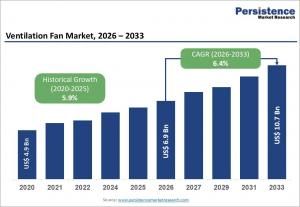
By AI, Created 7:16 AM UTC, June 01, 2026, /AGP/ – Persistence Market Research says the global ventilation fan market will grow from $6.9 million in 2026 to $10.7 million by 2033, driven by demand for better indoor air quality, energy efficiency and smarter building systems. North America leads the market, helped by strict building rules, replacement demand and stronger focus on ventilation.
Why it matters: - Ventilation fans are becoming more important as building owners and consumers focus on indoor air quality, humidity control and lower energy use. - The market is expanding across residential, commercial and industrial settings, which points to broader demand for air circulation systems in both new construction and upgrades. - North America dominates the market because of strict building regulations, strong replacement demand and a growing focus on indoor air quality.
What happened: - Persistence Market Research estimates the global ventilation fan market at US$ 6.9 million in 2026. - The same study projects the market will reach US$ 10.7 million by 2033. - The forecast implies a 6.4% compound annual growth rate from 2026 to 2033. - The report frames the market around rising demand from industries, commercial facilities and residential users.
The details: - Ventilation fans remove stale air, control humidity, reduce airborne contaminants and help maintain healthier indoor environments. - Poor ventilation can allow pollutants, allergens and excess moisture to build up indoors. - Governments and regulators are tightening building ventilation standards, which should support demand for advanced systems. - Construction remains one of the biggest end markets, driven by urban development, residential projects and commercial infrastructure growth. - Modern buildings are using ventilation fans to meet safety rules and energy-efficiency requirements. - Common applications include smart buildings, offices, shopping centers, hospitals and educational institutions. - Energy efficiency is shaping purchasing decisions, and manufacturers are developing fans that use less power while maintaining airflow. - Electronically commutated motors, variable-speed controls and smart monitoring systems are improving operating efficiency. - Industrial facilities use ventilation fans to remove heat, fumes, dust and airborne contaminants. - Manufacturing plants, warehouses, processing facilities and production units are key industrial users. - Healthcare facilities are also creating demand because hospitals, clinics, laboratories and healthcare centers need controlled airflow to reduce contamination risks. - Smart ventilation systems with sensors, automation and remote monitoring are gaining traction. - These systems can adjust airflow based on occupancy, humidity, temperature and air quality. - The report segments the market by product type, mounting type, material type, distribution channel, end-user and region. - Product types include axial, centrifugal, mixed flow, cross flow, inline, range hood, domestic exhaust and power roof fans. - Mounting types include wall-mounted, inline/duct-mounted, ceiling-mounted, window-mounted and roof-mounted fans. - Material types include metal, plastic and composite material fans. - Distribution channels include direct sales, distributors and dealers, specialty stores and online retail. - End users include construction, manufacturing, automotive, healthcare, hospitality and food and beverage. - Regions covered include North America, Europe, East Asia, South Asia & Oceania, Latin America, and the Middle East & Africa. - The report highlights market forecasts, competitive intelligence, growth factors, strategic initiatives, pricing analysis, future opportunities and revenue pockets.
Between the lines: - The market story is less about a single product category and more about the convergence of regulation, health concerns and building efficiency. - Smart controls and connected features are becoming differentiators, not just add-ons, as buyers look for systems that can respond automatically to conditions indoors. - Regional growth outside North America appears tied to urbanization, infrastructure buildouts and industrial expansion, suggesting a mix of replacement demand in mature markets and first-time adoption in faster-growing ones.
What’s next: - Growth is expected to continue as construction, industrial output and healthcare infrastructure investment expand. - Manufacturers focusing on innovation, sustainability and smart ventilation systems may gain an edge as buyers prioritize efficiency and indoor air quality. - The report says the market is poised for steady expansion through 2033. - More information is available in the free sample report, the customized report request and the full report checkout page.
Disclaimer: This article was produced by AGP Wire with the assistance of artificial intelligence based on original source content and has been refined to improve clarity, structure, and readability. This content is provided on an “as is” basis. While care has been taken in its preparation, it may contain inaccuracies or omissions, and readers should consult the original source and independently verify key information where appropriate. This content is for informational purposes only and does not constitute legal, financial, investment, or other professional advice.
Sign up for:
Energy Watch: Middle East
The daily local news briefing you can trust. Every day. Subscribe now.
Check Your Email!
We sent a one-time activation link to: .
Confirm it's you by clicking the email link.
If the email is not in your inbox, check spam or try again.
Welcome back!
is already signed up. Check your inbox for updates.