

Next-generation batteries could redefine the future of energy storage
Self-healing polymer electrolytes for next-generation lithium batteries. Credit: Renewable Energy - Volume 3: Energy Storage Systems - Fuel Cells, Supercapacitors, and Batteries. DOI: https://doi.org/10.1016/B978-0-443-29875-2.00015-2
A recent study stresses the need for a chemistry-neutral battery roadmap beyond 2030 to accelerate the shift toward climate-neutral energy-storage technologies.
SHARJAH, EMIRATE OF SHARJAH, UNITED ARAB EMIRATES, February 12, 2026 /EINPresswire.com/ -- Drawing on an extensive survey of emerging battery chemistries and design innovations, researchers at the University of Sharjah are pointing to transformative technologies poised to meet the escalating energy demands of an increasingly electrified world.
Yet, despite the rapid advancements, they caution that today’s lithium-ion systems are nearing their theoretical performance. This reality underscores the urgent need for new materials, safer designs, and more sustainable alternatives capable of supporting the infrastructure of electric energy and meeting the world’s almost insatiable thirst for clean energy.
These insights are presented in a newly published study within the volume titled Renewable Energy - Volume 3: Energy Storage Systems - Fuel Cells, Supercapacitors, and Batteries. The work “discusses the current trends in battery technology and explores the potential for next-generation batteries. It emphasizes the growing demand for energy storage devices in different sectors, with rapid technological advancements in society.” (https://doi.org/10.1016/B978-0-443-29875-2.00015-2)
The study examines the rising adoption of automation, electric transportation, and renewable energy storage. It also details the limitations of current battery systems and identifies the critical factors that must guide the design of next-generation battery technologies.
“New technologies utilized in modifying traditional batteries to meet the growing demand across different sectors are briefly stated,” the authors note, adding that “the 2030 roadmap for the development of next-generation battery technology is discussed.”
From their wide-ranging assessment of the current electric battery landscape, the authors find that the future hinges on building systems with high power and energy densities. Together, these characteristics promise “solutions across many applications,” highlighting the sector’s vast potential for improvement and innovation in pursuit of “better energy efficiency, safety, affordability, and sustainability.”
Limits of lithium-ion technology verses rising demand
The authors emphasize that rapid technological advancement is driving an unprecedented surge in demand for energy storage devices, particularly in the field of electric mobility. Their data indicates that electric transportation alone could account for nearly 89% of all battery applications by 2030, underscoring the sector’s dominant influence on future battery markets.
They further warn that global battery manufacturing capacity must expand dramatically to meet this surge in demand. According to their estimates, “Annual production must be close to 6700 GWh in 2031. By 2050, it is anticipated that the base metal production (e.g., copper, aluminum, nickel) might increase five- to sixfold. As far as lithium is concerned, the metal demand could be much higher (almost 100 times its current level).”
Such massive expansion raises urgent concerns about the long-term availability and sustainability of key resources, especially lithium for long-term utilization. The authors note that although lithium-based batteries dominate the market and are extensively studied, “it is equally important to explore other metal-based batteries. This will reduce the dependence on a particular battery type and might even open opportunities for new and advanced applications.”
With continued development, the authors project the energy density of lithium-ion batteries (LIBs) to reach “500 Wh kg−1 by 2030,” but safety and long-term stability remain among the major challenges. One of the most critical barriers to overcome relates to thermal runaway, which they describe as “a major limiting factor” triggered by electrode decomposition and excessive heat generation. The study also emphasizes that efforts to push energy density can introduce new trade-offs.
LIBs, or lithium-ion batteries, are widely valued for their high performance. They combine rechargeability with high energy density and long cycle life. These qualities make them the leading choice for power grid storage, portable electronics, and electric vehicles.
However, the authors caution that the drive to design large-capacity, high-energy-density power batteries has some inherent risks to address. They argue that such designs “may lead to compromises in safety or cycle performance.” For this reason, they assert that any strategy to boost energy density “must consider various factors for enhancing the performance that do not compromise the battery’s safety.”
Thus, they reiterate that there is limited “development of new process technologies and electrode material systems to achieve high energy density in LIBs.”
Beyond Lithium-Ion: Exploring New Battery Chemistries
As lithium-ion systems approach their practical performance limits, researchers are increasingly shifting their focus toward alternative battery chemistries that promise higher energy potential and lower cost. The authors highlight growing interest in technologies such as lithium–sulfur (Li–S) batteries and sodium, zinc, and aluminum batteries which they see as viable next-generation options.
Over the last five years, there has been significant interest in Li–S battery research due to their high theoretical energy density and lower material cost. The authors note that “there is a possibility of Li-S being a better alternative to the Li-ion battery market,” emphasizing their future potential to become the most promising next-generation options to conventional LIBs.
However, despite rapid research progress, the authors caution that commercialization remains challenging, with persistent issues such as dendrite growth, shuttle effects, and limited cycle life hindering large-scale deployment.
Another promising pathway toward higher future density, according to the authors, is lithium-metal batteries. Replacing graphite anodes with lithium metal can significantly boost battery energy density from about 250 to as high as 440 Wh kg⁻¹, they note. This translates into significantly additional energy stored in the same space. Yet, they stress that this advantage comes with serious safety concerns. Lithium metal is prone to dendrites that can penetrate separators and cause short circuits, and it reacts easily with flammable electrolytes.
To mitigate these risks, the authors emphasize that innovations in electrolyte design are crucial. They highlight approaches such as “localized high-concentration electrolytes” and solid-state electrolytes to improve safety and reduce dendrite growth.
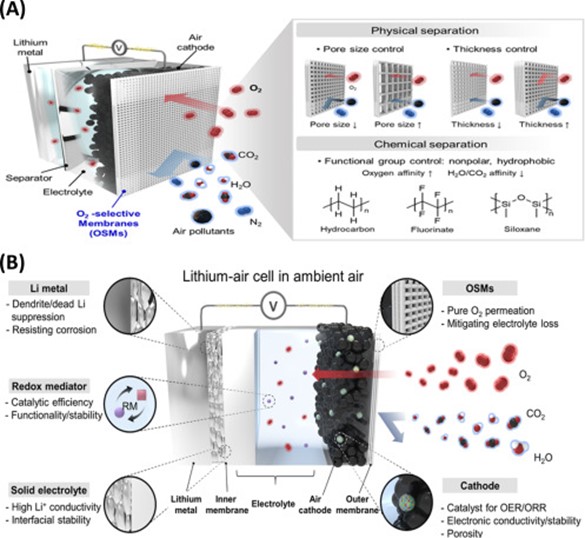
Meanwhile, they add that lithium–air batteries are being explored for electric vehicle applications due to their exceptionally high theoretical energy density. “Lithium-air batteries use oxygen to achieve ultra-high energy density,” with theoretical values reaching “3505 Wh kg-1.” The central challenge, however, is developing systems capable of operating safely in ambient air rather than relying on pure oxygen environments.
For large-scale renewable energy storage, the authors point to flow batteries, particularly redox flow batteries (RFBs), as practical candidates. Their ability to store their electrolytes in external tanks allows energy and power to scale independently, making them especially suitable for long-duration grid applications.
Beyond advances in chemistry, the authors argue that the next generation of batteries will rely heavily on new, user-oriented functionalities. One promising example is self-healing polymer electrolytes, which can repair internal damage during operation, slowing degradation and extending lifespan.
The authors note that integrating such materials “can ensure a long cycling lifetime. The financial and safety challenges of current battery technology can be addressed. Self-healing is possible to achieve when the material has the required structural traits that respond automatically to a stimulus and initiate the restoration of the original properties without external intervention.”
Micro-batteries are also expected to become increasingly important, particularly in healthcare monitoring and Internet of Things devices. Another emerging direction is biodegradable batteries, especially for medical applications, where power sources must be “nontoxic and reliable with high energy density,” the authors contend.
Looking further ahead, the study highlights the European BATTERY 2030+ initiative as a strategic roadmap for transforming these concepts into practical technologies. Rather than focusing on a single chemistry, the initiative promotes a chemistry-neutral strategy, aiming to accelerate the discovery of interfaces and materials, incorporate smart functionalities such as sensing and self-healing, and advance the manufacturing and recycling processes.
The authors emphasize that artificial intelligence and machine learning are expected to play a central role in this transition. These tools can spur research to go beyond the current slow trial-and-error experimentation by enabling predictive design and faster material discovery.
Summing-up: toward a sustainable battery future
The authors conclude that next-generation battery development must advance in step with accelerating technological progress and rising energy demand. While lithium-ion batteries remain critical to today’s energy-storage landscape, they emphasize that emerging systems, including metal-sulfur, metal-air, sodium-ion, and advanced flow battery chemistries, are expected to play an increasingly significant role in the future.
They write, “Although Li-ion batteries are currently at the forefront of energy storage, new technologies such as metal-sulfur, metal-air, and organic RFBs are being actively researched. The introduction of sophisticated technology in different applications demands innovative battery designs such as micro-batteries and flexible batteries.
“The research and development of next-generation batteries should be in line with the progress in technology. They should also meet the increasing demand for energy consumption. In short, batteries with enhanced performance, flexibility in design, and simple integration are anticipated in all sectors.”
Innovations such as solid-state electrolytes, self-healing materials, flexible and micro-scale battery designs, biodegradable components, and hybrid storage systems could collectively redefine energy storage for a climate-neutral future. As they observe, “The development of self-healing components in batteries makes them safer and more reliable. Biodegradable batteries are required in the medical industry and also to meet sustainability goals. The chemistry-neutral approach for the development of next-generation batteries… will accelerate current battery research.”
LEON BARKHO
University Of Sharjah
+971 50 165 4376
email us here
Legal Disclaimer:
EIN Presswire provides this news content "as is" without warranty of any kind. We do not accept any responsibility or liability for the accuracy, content, images, videos, licenses, completeness, legality, or reliability of the information contained in this article. If you have any complaints or copyright issues related to this article, kindly contact the author above.
